LearnUpon vs e-KHOOL: Compliance Management for UK Banks & Insurers
The regulatory ecosystem governing the United Kingdom's financial services industry in 2026 is defined by uncompromising scrutiny, continuous oversight, and stringent accountability mechanisms. For Chief Compliance Officers (CCOs), Heads of Regulatory Risk, and HR Directors across UK retail banks, commercial institutions, challenger banks, and reinsurers, ensuring organizational readiness demands robust technological infrastructure. Selecting the right digital learning ecosystem is no longer merely an HR decision; it is a core risk mitigation strategy. This analysis evaluates two prominent platforms LearnUpon and e-KHOOL examining how each supports digital governance, regulatory training, and auditing requirements.
The Escalating Compliance Demands on UK Banking and Insurance
UK financial institutions operate under one of the world’s most stringent regulatory umbrellas. The Financial Conduct Authority (FCA) and Prudential Regulation Authority (PRA) have intensified their oversight around operational resilience, individual accountability, and consumer protection. Compliance Management for UK Banks and Insurers requires continuous monitoring rather than passive annual check-boxes.
Key regulatory frameworks currently driving operational complexity include:
• The Senior Managers and Certification Regime (SM&CR): Demanding meticulous tracking of Conduct Rules training, annual fitness and propriety attestations, and personal legal accountability for certified staff.
• FCA Consumer Duty Rules: Requiring firms to actively demonstrate that employees deliver good outcomes for retail customers, backed by verifiable educational metrics.
• PRA Solvency II & Insurance Distribution Directive (IDD): Mandating minimum continuous professional development (CPD) hours and technical competence tracking across insurance underwriting and distribution.
• Anti-Money Laundering (AML) & Counter-Financing of Terrorism (CFT): Mandating high-frequency, role-specific training with impenetrable audit trails to prevent systemic financial crime.
The Role of Modern eLearning software in Regulated Environments
Deploying modern enterprise eLearning software transforms regulatory training from an administrative burden into a proactive risk-management function. Legacy learning architectures often fail under audit because they lack granular tracking, real-time reporting, and rigorous access controls. Advanced digital learning infrastructure ensures that policies are not only distributed but understood, verified, and recorded.
When evaluating digital platforms, UK financial risk executives execute a systematic 6-stage workflow:
1. Regulatory Requirement Mapping: Aligning specific FCA/PRA rules directly to learning modules.
2. Architecture Assessment: Evaluating multi-tenant hosting, data sovereignty, and security protocols.
3.User/RoleSegmentation:Establishingautomatedlearningpathsbasedonjobtitles,seniority,and regulatory classification.
4. Testing & Verification: Utilizing anti-cheat mechanisms and randomized question banks to ensure genuine knowledge absorption.
5. Audit Trail Generation: Generating immutable, time-stamped reporting logs for regulatory inspection.
6. Automated Recertification: Configuring recurring training schedules to maintain continuous compliance across annual regulatory cycles.
Platform Overviews : LearnUpon vs. e-KHOOL
While both systems serve enterprise learning environments, their underlying architectural philosophies appeal to distinct operational needs.
LearnUpon LMS Overview
LearnUpon is an established enterprise multi-portal learning management system engineered for multi-audience training delivery. Known for its scalable portal architecture, LearnUpon allows institutions to manage employee, partner, and customer education within isolated, custom-branded environments managed from a centralized dashboard. It excels at cross-departmental scaling and enterprise HR ecosystem integrations.
e-KHOOL Platform Overview
e-KHOOL is a highly specialized, cloud-based compliance LMS engineered specifically for high-security, heavily regulated sectors. Featuring native AI compliance training capabilities, rigorous content protection (anti-leak watermarking and access locking), and automated recertification workflows, e-KHOOL operates as a dedicated regulatory training software engine designed to enforce compliance discipline and audit readiness cost-effectively.
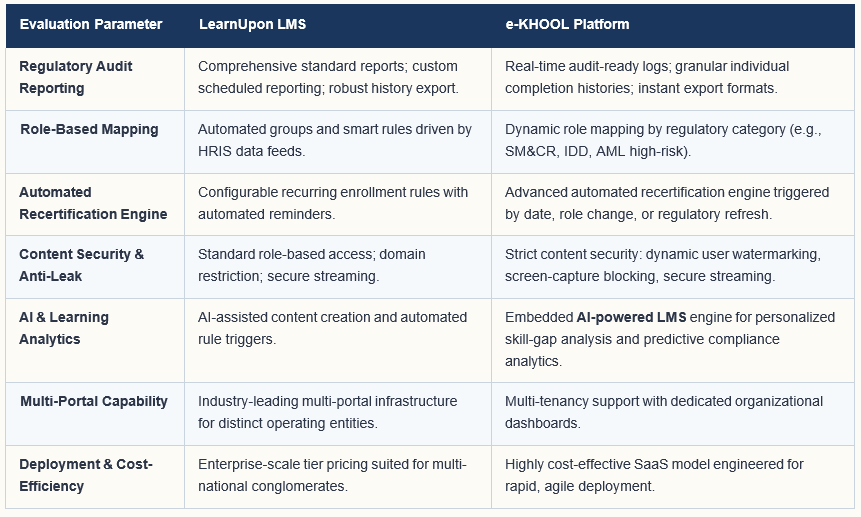
Head-to-Head Feature Comparison Matrix
Managing Specific Regulatory Frameworks: SM&CR, Consumer Duty, and Solvency II
Banking Focus: SM&CR and Consumer Duty
Under the Senior Managers and Certification Regime, UK banks must track Conduct Rules training for all certified personnel. Compliance Management for UK Banks and Insurers demands that training records hold up under direct FCA scrutiny. LearnUpon uses smart group automation to assign Conduct Rules courses based on employee profiles synced from HRIS software. Meanwhile, e-KHOOL enhances this process by leveraging its AI-powered LMS engine to identify knowledge gaps among Senior Managers, delivering targeted micro-learning modules to ensure complete coverage before annual "Fit and Proper" attestations.
Insurance Focus: Solvency II and IDD Compliance
Insurers and reinsurers governed by Solvency II and the Insurance Distribution Directive must track mandatory continuous professional development (CPD) hours. Utilizing a robust finance LMS like LearnUpon allows insurance firms to distribute training across diverse broker networks via multi-portal setups. Conversely, e-KHOOL operates as an ideal compliance training software by strictly enforcing minimum time-in-module tracking, interactive checkpoints, and automated CPD certificate issuance.
Knowledge Verification, Testing Rigour, and Anti-Cheat Controls
Supervisory bodies reject "click-through" training where employees bypass educational material. Modern eLearning software must enforce active engagement.
When serving as an effective LMS for financial services, both platforms offer robust assessment engines, but with differing security focuses:
• LearnUpon: Supports randomized question pools, configurable passing thresholds, mandatory retake logic, and SCORM/xAPI tracking. It provides a highly smooth user experience for diverse corporate learners.
• e-KHOOL: Prioritizes high-stakes verification as a dedicated LMS for compliance training. It incorporates randomized quiz banks, timed response constraints, forced video playback, and proprietary dynamic content watermarking (displaying the viewer's ID and IP address across the screen) to prevent unauthorized distribution and proxy test-taking.
Enterprise Infrastructure, Integrations, and Security Protocols
To qualify as the best LMS for finance, a solution must integrate seamlessly with an institution’s existing IT infrastructure while maintaining rigorous data sovereignty.
Both platforms support core enterprise standards:
• Single Sign-On (SSO): Full integration with SAML 2.0, Azure AD, and Okta for secure identity management.
• HRIS Integrations: Seamless synchronization with Workday, BambooHR, and SAP SuccessFactors to automate onboarding and offboarding workflows.
• Data Sovereignty & Security: Alignment with UK GDPR, ISO 27001 standards, and EU-US Data Privacy Frameworks, ensuring sensitive compliance records remain protected.
AI Capabilities in Financial Compliance Learning
The integration of artificial intelligence marks a major evolution in learning management software. However, in regulated financial environments, AI deployment must balance innovation with governance.
e- KHOOL utilizes an advanced AI-powered LMS framework to deliver adaptive learning paths, automatically adjusting course difficulty and suggesting targeted remediation based on assessment performance. This AI compliance training model accelerates time-to-competence for staff handling complex subjects like credit risk training. LearnUpon focuses its AI capabilities on streamlining administrative workflows, content generation, and search optimization. In both instances, institutions must maintain human oversight to ensure AI-driven paths align with FCA regulatory expectations.
Decision Framework: Which Platform Should Your Organisation Choose?
Selecting between these two top-tier platforms depends on your institution's specific structural and strategic goals:
Choose LearnUpon if:
• Your financial institution operates complex, multi-entity corporate structures requiring distinct, white-labelled portals for internal employees, external distribution partners, and corporate clients.
• You require a broad enterprise eLearning platform to manage soft-skills, leadership, and operational training alongside compliance modules.
• Your budget aligns with tier-one enterprise software investments prioritizing global multi-audience administration.
Choose e-KHOOL if:
• Your primary focus is securing dedicated compliance training LMS technology built specifically to automate regulatory tracking, recertifications, and audit reporting.
• You require advanced content security features, including dynamic watermarking and screen-capture protection to safeguard proprietary financial services compliance training materials.
• You seek an agile, cost-effective LMS in banking or insurance that leverages embedded AI for rapid deployment and automated skill-gap analysis.
How e-KHOOL Delivers Compliance Management for UK Banks and Insurers
e- KHOOL has established itself as an agile, highly secure platform designed to meet the rigorous demands of modern regulatory governance. By serving as a specialized financial services learning platform, e-KHOOL simplifies the administration of complex regulatory frameworks.
Key operational strengths include:
• Automated Audit Trails: Generating instant, tamper-evident logs mapping individual user completion, assessment scores, and time-in-module to satisfy FCA/PRA inquiries.
• Integrated Recertification Engines: Automatically resetting compliance cycles annually for Conduct Rules and AML refreshers without manual HR intervention.
• Secure Content Delivery: Safeguarding internal risk policies through state-of-the-art anti-leak technology.
By delivering robust software controls, e-KHOOL empowers UK financial institutions to maintain continuous operational readiness.
Platform Selection & Migration Checklist
☐ Define Regulatory Scope: Identify specific FCA, PRA, SM&CR, and Solvency II tracking requirements.
☐ Evaluate Data Security: Confirm UK/EU data hosting compliance, ISO certification, and SSO compatibility.
☐ Assess Anti-Cheat & Content Protection: Verify dynamic watermarking, timed testing, and randomized question bank capabilities.
☐ Test HRIS Integration: Ensure automated synchronization with Workday or primary HR systems.
☐ Review Audit Reporting Capabilities: Confirm reports can be exported immediately in formats required by regulatory examiners.
☐ Verify Recertification Automation: Test automated enrollment triggers for annual compliance cycles.
☐ Audit AI Governance: Ensure AI features operate transparently with human oversight options.
☐ Execute Sandbox Trial: Conduct a hands-on trial of both LearnUpon and e-KHOOL using actual enterprise compliance scenarios.
Frequently Asked Questions
1. How does modern elearning software ensure FCA audit readiness?
Enterprise elearning software maintains time-stamped, immutable completion logs, assessment scores, and version-controlled course records. These automated reporting features allow compliance officers to produce precise, verifiable audit trails instantly during regulatory inspections.
2. Does deploying e-KHOOL or LearnUpon guarantee legal regulatory compliance?
No. Both LearnUpon and e-KHOOL provide software tools to host, track, and report on training. Neither platform provides legal advice or compliance immunity. Ultimate legal liability remains strictly with the financial institution and its Senior Management.
3. What is the best LMS for finance institutions managing SM&CR tracking?
The best LMS for finance firm SM&CR tracking is one that offers dynamic role mapping, automated annual recertification, and granular reporting. Both LearnUpon and e-KHOOL support these features, with e-KHOOL offering specialized AI-driven skill gap mapping for certified roles.
4. How do these platforms handle annual recertification cycles for AML and Conduct Rules?
Both systems feature automated recertification engines that automatically enroll employees in mandatory refresher training based on configurable date rules, role changes, or annual regulatory deadlines, eliminating manual administrative tracking.
5. Can e-KHOOL prevent employees from sharing or leaking sensitive training content?
Yes. e-KHOOL includes advanced content security controls such as dynamic dynamic user watermarking (displaying learner IP and ID), screen-capture prevention, and secure streaming to protect intellectual property and internal policy documentation.
Choosing the Right eLearning software for Strategic Compliance
Navigating the complex regulatory landscape of 2026 requires UK banks, insurers, and financial institutions to adopt robust digital infrastructure. Choosing between LearnUpon and e-KHOOL ultimately hinges on institutional priorities. LearnUpon offers unmatched multi-portal scalability for broad enterprise learning, making it an excellent choice for large multi-audience environments. Conversely, e-KHOOL delivers a highly focused, AI-driven, and secure platform specifically optimized for compliance tracking, content protection, and rapid audit readiness.
By implementing targeted eLearning software tailored to your institution's governance framework, compliance leadership can mitigate operational risk, streamline auditing, and foster an organizational culture of continuous regulatory alignment.