How Better Compliance Training with a Learning Management System Improves Policy and Process Adoption
Egypt's Information and Communication Technology (ICT) sector is expanding rapidly across software development, telecommunications, IT outsourcing, and managed cloud services. As Egyptian tech firms scale operations across Cairo, Alexandria, and international markets, HR leaders and compliance managers face a critical challenge: ensuring that every developer, engineer, and system administrator adheres to essential security protocols, data handling rules, and internal governance policies.
Simply distributing policy documents or conducting occasional orientation lectures rarely leads to meaningful policy adoption. When compliance training is treated as a passive checklist, employees quickly forget crucial protocols, leaving organizations vulnerable to security gaps and operational errors. Implementing a centralized digital infrastructure through a modern learning management system enables Egyptian ICT companies to transform static compliance policies into structured, interactive learning programs that drive genuine process adoption and long-term organizational accountability.
Understanding Compliance Training Challenges in Egypt's ICT Industry
Technology organizations operating in Egypt manage fast-paced onboarding cycles, remote development teams, and complex technical environments. Software engineers, QA leads, and cloud architects regularly handle sensitive customer data, corporate intellectual property, and critical network infrastructure, making continuous policy alignment essential.
However, many technology firms still rely on manual or fragmented administrative processes to manage regulatory and internal compliance training. Relying on legacy tools introduces significant operational friction:
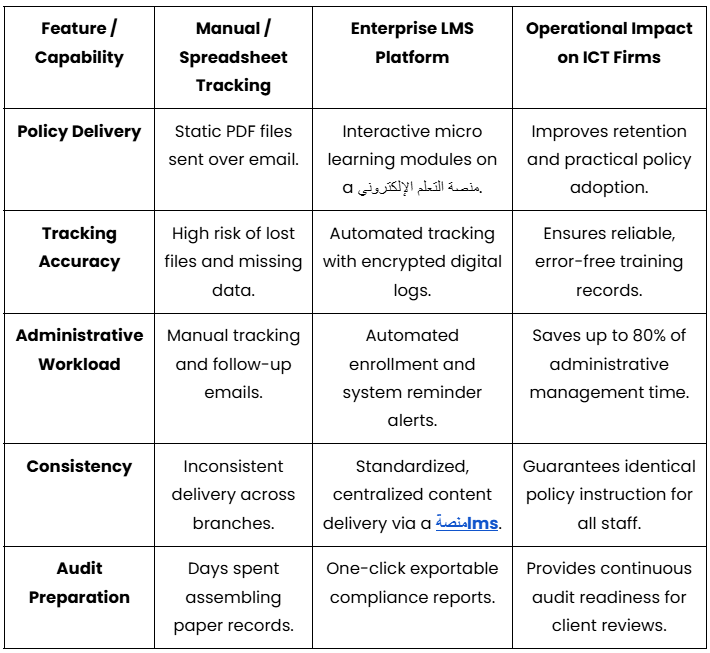
Decentralized Records: Storing policy acknowledgments across local HR folders, email chains, and isolated spreadsheets creates fragmented records, making audit preparation difficult.
Passive Engagement: Sending long policy PDFs via email results in low engagement. Employees often mark documents as read without fully reading or understanding the protocols.
Inconsistent Delivery: When different branches or department leads run orientation sessions manually, staff receive varying interpretations of core company procedures.
Manual Tracking Overhead: Compliance officers and L&D managers spend hours manually logging quiz results, emailing late submitters, and verifying employee status.
Lack of Performance Monitoring: HR leads struggle to identify which departments or employee tiers understand protocols and which require additional training.
Why ICT Companies Need a More Structured Compliance Training Approach
Adopting new operational processes or security frameworks requires more than a one-time presentation. A newly hired software engineer needs immediate onboarding compliance covering code repository rules, access control policies, and non-disclosure agreements. Simultaneously, existing technical staff require annual refreshers on cybersecurity hygiene, remote work safety, and data privacy protocols.
To build an accountable workforce, ICT companies need a structured digital framework that embeds learning directly into administrative workflows. Moving away from reactive tracking toward robust corporate learning management systems enables HR leaders to create organized, role-based learning pathways.
A structured framework ensures that every team member—whether working from an office in Smart Village or remotely from another governorate—receives identical policy instruction, takes standardized assessments, and completes mandatory training on time.
How an LMS Can Simplify Compliance Training
A specialized corporate learning management system serves as a central administrative platform for organizing, delivering, and evaluating enterprise training initiatives. Rather than using disconnected tools, an LMS unifies the entire training lifecycle into a single workflow:
Centralized Course Management: Administrators can upload, organize, and manage internal training courses, policy documents, instructional videos, and interactive learning modules in one repository.
Automated Employee Enrollment: HR managers can establish automated rules that enroll new hires in mandatory compliance paths on their first day based on job roles or technical tiers.
Learning Material Management: Platform tools allow administrators to structure content logically, set prerequisite rules, and update policy materials instantly across all departments.
Assessments and Quizzes: Built-in evaluation engines allow compliance leads to create knowledge checks and quizzes to verify that staff comprehend critical procedures.
Real-Time Completion Tracking: The system logs learner progress as it occurs, recording module views, test scores, attempt limits, and completion timestamps automatically.
Performance Monitoring: Interactive dashboards visualize completion rates across divisions, allowing HR to identify non-compliant departments before deadlines pass.
Automated Reports and Analytics: Compliance officers can generate clear, audit-ready reports filtered by department, job role, or completion status in just a few clicks.
Centralized Administrator Control: Granular permission settings allow HR leads, compliance leads, and department heads to manage users, monitor progress, and maintain security over learning records.
Benefits of Using an LMS for Compliance Training in ICT Companies
Deploying dedicated learning management Solutions offers distinct operational and strategic benefits for technology enterprises in Egypt:
Reduced Administrative Workload
Automating enrollments, completion tracking, and reminder notifications eliminates repetitive manual work, enabling HR personnel to focus on higher-value talent initiatives.
Better Training Visibility and Monitoring
Compliance leads gain total transparency over employee progress. Real-time dashboards remove guesswork, allowing managers to monitor completion rates across Cairo, Alexandria, or remote teams at any moment.
Consistent Training Delivery
Using a unified digital platform ensures that every developer, project manager, and system engineer receives the exact same approved policy details, raising overall operational standards.
Scalable Training Management
As ICT firms expand headcount or open new regional offices, a cloud-based learning management system egypt scales seamlessly to onboard hundreds of new learners without increasing administrative complexity.
How e-KHOOL Can Support Compliance Training Management
When evaluating digital infrastructure to manage corporate training workflows, e-KHOOL offers an enterprise-grade LMS software platform built for administrative control and learning efficiency. Positioned strictly as an LMS platform technology, e-KHOOL provides the digital foundation that allows Egyptian ICT organizations to host, organize, monitor, and report on their own custom learning initiatives.
e-KHOOL is an LMS software technology platform—it does not create, sell, or provide pre-packaged compliance content, nor does it issue legal or regulatory certifications. Egyptian technology enterprises use e-KHOOL to upload their proprietary policy materials, design custom evaluations, manage user permissions, and track internal workforce performance data.
Through the e-KHOOL platform, compliance managers gain complete operational control over:
Internal Content Management: Upload and organize internal SCORM packages, policy PDFs, instructional videos, and onboarding presentations directly within the system.
User and Role Management: Group learners by department, job function, or technical tier, assigning tailored learning pathways based on specific job roles.
Localized User Experience: Featuring full Arabic and English language support, e-KHOOL functions as a versatile منصة التعلم الالكتروني that caters to diverse, bilingual engineering teams.
Custom Assessment Configuration: Design quizzes with flexible passing thresholds, question randomization, and attempt rules tailored to internal governance standards.
Automated Analytics and Reporting: Access real-time analytics engines to generate completion summaries, track assessment score distributions, and export verifiable training logs for executive review.
By using e-KHOOL to handle user management, content delivery, and progress tracking, Egyptian ICT firms gain an efficient, scalable foundation for corporate compliance training.
A Practical Scenario for an Egyptian ICT Company
Consider a fast-growing cloud solutions provider based in Smart Village, Cairo, with 250+ employees, including remote DevOps engineers and offsite consultants supporting enterprise clients across the region.
The Operational Challenge
The firm updated its internal data privacy guidelines and remote access security procedures. HR emailed the updated PDF policy to all staff, asking them to read the document and sign an attached digital acknowledgment form.
A month later, an internal review revealed that while 85% of employees signed the form, many engineers were still violating basic access protocols. HR had no way of knowing whether employees had actually read or understood the new guidelines, and manually tracking signed forms across multiple departments required weeks of administrative follow-up.
The LMS-Based Solution
The organization transitioned its compliance management to e-KHOOL’s platform:
Centralized Program Setup: HR converted the policy into short, interactive modules, added a brief video explanation, and built a mandatory 10-question comprehension quiz inside the portal.
Automated Assignment: All technical personnel were automatically enrolled in the new module with a strict 10-day completion window.
Automated Reminders: System notifications automatically nudged staff who had not yet finished the course 5 days and 2 days before the deadline.
Verifiable Assessment: Employees had to score at least 80% on the quiz to complete the training, ensuring they understood the core procedures.
Instant Reporting: The compliance officer checked the administrative dashboard daily to monitor completion rates by department, generating an executive report in under two minutes that confirmed 100% verified policy adoption.
Key Considerations When Choosing an LMS for Compliance Training
Selecting the right platform is a strategic decision for HR managers, L&D leaders, and IT heads. Decision-makers should evaluate potential systems against key administrative and operational criteria:
Ease of Administration: The platform must allow HR staff to easily upload content, enroll users, and adjust learning paths without needing technical software development skills.
Course and Content Management: Look for systems that support multiple format types (SCORM, PDF, video) and allow easy content updates whenever internal policies change.
Flexible Assessment Tools: The software should offer versatile quiz configurations, passing score settings, timed tests, and automated grading to accurately evaluate knowledge retention.
Robust Tracking and Reporting: Real-time dashboards, completion analytics, and exportable reports (Excel/PDF) are essential for executive visibility and audit preparedness.
Bilingual Capability: In Egypt’s business environment, full Arabic and English interface support ensures smooth adoption across all staff levels.
System Scalability: Ensure the platform can accommodate expanding employee numbers, custom role permissions, and multi-location organizational structures smoothly.
Conclusion
For technology companies, telecommunications providers, and IT service vendors operating in Egypt, building a compliant, policy-aligned workforce is critical to operational success and risk reduction. Managing compliance training through static emails, manual sign-offs, and fragmented spreadsheets creates administrative burdens and fails to ensure genuine policy adoption.
Adopting an enterprise learning management system enables compliance leaders to transform static policies into structured, trackable learning programs that drive actual process adherence. As a flexible LMS platform technology, e-KHOOL LMS provides Egyptian ICT organizations with the digital foundation needed to streamline internal training, eliminate administrative bottlenecks, and maintain continuous workforce readiness across all locations.