Can One Platform Handle Training for Multiple Employee Groups? | UAE BFSI Compliance LMS Guide 202
In UAE banking, financial services, and insurance (BFSI) organisations workforce training is rarely uniform. A front-line teller in Dubai, a compliance officer in Abu Dhabi, a risk analyst, and an executive board member all operate under vastly different daily mandates, risk profiles, and regulatory expectations.
For Human Resources, Learning & Development (L&D), and Risk & Compliance leadership, this reality raises a pressing operational question: Can a single, centralized compliance training platform handle the unique training requirements of multiple employee groups without degrading into administrative chaos?
The short answer is yes. Modern enterprise learning technologies make it fully possible to manage distinct learning paths, mandatory compliance requirements, assessments, and audit trails within one unified system. Doing so, however, requires moving away from one-size-fits-all course distributions toward a structured, role-based architecture.
This practical guide explores why different workforce segments require tailored training, how a single system structures complex learning requirements, and how UAE financial institutions can transition from fragmented processes to streamlined, audit-ready compliance management.
Why Different Employee Groups Require Distinct Training Requirements
In a tightly regulated sector like UAE BFSI, treating all employees as a single learning audience creates significant operational risks. Employee roles vary widely in their exposure to operational, financial crime, and regulatory risks. Consequently, training programs must reflect specific job duties and risk exposure levels.
Consider how learning requirements diverge across typical operational groups within a UAE bank or insurance firm:
New Employees: Require foundational onboarding alongside mandatory baseline compliance. For instance, regulatory standards established by the Central Bank of the UAE (CBUAE) stipulate that new joiners must receive comprehensive Anti-Money Laundering and Countering the Financing of Terrorism (AML/CFT) compliance training within thirty (30) calendar days of joining, during which they must not serve customers independently until completion.
Customer-Facing Teams (Branch Staff, Wealth Managers): Directly interact with clients and execute Customer Due Diligence (CDD) / Know Your Customer (KYC) procedures. They need practical, scenario-based learning on red flags, Politically Exposed Persons (PEPs) screening, and sanction checks. Under CBUAE guidelines, staff dealing directly with customers or products must undergo refresher training at least annually.
Compliance & Financial Crime Teams: Require deep, technical training on evolving money laundering, terrorist financing, and proliferation financing (AML/CFT/CPF) typologies, trade-based financial crime, and regulatory reporting procedures.
Risk & Operations Teams: Need targeted learning on operational risk frameworks, transaction monitoring protocols, internal escalation pathways, and data protection standards.
Managers & Senior Leadership: Require governance-focused modules emphasizing supervisory oversight, risk culture, regulatory reporting duties, and accountability frameworks.
Technology & Support Staff: Focus on information security, UAE National Cybersecurity Standards (NESA) alignment, and systems integrity.
Because regulatory frameworks demand that training be tailored, role-specific, and risk-sensitive, deploying uniform training across all groups leads either to over-training staff on irrelevant topics or failing to adequately prepare high-risk units.
How a Single Compliance Training Platform Structures Complex Requirements
To manage multi-audience complexity without administrative burden, a best learning management software relies on automated grouping, dynamic mapping, and automated rule engines.
Rather than maintaining separate systems for corporate training, technical learning, and regulatory compliance, a centralized lms platform structures learning through a multi-tiered hierarchy:
Key Architectural Capabilities
Dynamic Employee Groups & Role Profiles: The elearning platform synchronizes with your HRIS (e.g., SAP SuccessFactors, Workday, or local HR tools) to dynamically group staff by location, department, seniority, or job function. When an employee’s role changes, their training profile updates automatically.
Role-Based Learning Paths: Admins set up structured learning sequences tailored to job functions. A customer service representative receives front-line AML and consumer protection tracks, while an IT engineer receives cybersecurity and data privacy tracks.
Automated Mandatory & Recurring Training: Regulations often dictate periodic refresher cycles. A compliance LMS automates annual, bi-annual, or trigger-based training workflows, sending automated notifications, tracking completion deadlines, and escalating overdue modules to managers.
Assessments and Certification Management: Tailored pass marks, randomized question banks, and timed knowledge checks ensure genuine comprehension. Upon successful completion, the platform generates verifiable digital certificates and tracks renewal timelines.
Centralized Compliance Reporting: L&D and compliance teams gain real-time visibility into organization-wide completion rates, departmental pass ratios, and individual progress logs, generating audit-ready reports instantly.
Practical Example: Managing Multiple Groups in a UAE Financial Institution
To visualize how this works in practice, consider this hypothetical scenario of a UAE-based financial institution managing its annual workforce learning calendar via a single compliance training platform.
In this setup, administrators do not manually assign courses to individual staff. Instead, when HR onboard a new branch clerk in Sharjah, the LMS software automatically detects their role and branch code, enrolling them into Group A (New Joiners) and Group B (Customer-Facing Staff).
The employee completes foundational AML within their first 30 days, transitions smoothly into branch-specific modules, and is scheduled for automated annual refreshers 12 months later all without manual intervention from L&D.
Step-by-Step Implementation Workflow
Transitioning your organization to a centralized elearning management system follows an 11-step operational workflow:
Identify Employee Groups: Categorize your workforce by department, risk level, physical location, and contractual status (full-time, temporary, contractor).
Define Training Requirements: Establish internal standards and map regulatory expectations (e.g., CBUAE rules, DFSA/FSRA mandates, Sanctions obligations) for each group.
Map Learning to Roles: Build matrix-based profiles linking specific learning tracks to job titles.
Assign Training Automatically: Establish HRIS auto-sync rules to trigger enrollments upon hire, transfer, or promotion.
Deliver Learning Multi-Channel: Offer accessible digital learning via desktop and mobile devices to accommodate shift workers and remote staff.
Assess Knowledge: Utilize pre- and post-module quizzes, scenario tests, and practical evaluations to verify understanding.
Track Completion Real-Time: Monitor dashboard metrics showing real-time engagement and completion percentages across divisions.
Monitor Overdue Training: Automate escalating reminders to learners, line managers, and compliance supervisors for late completions.
Manage Certifications: Track completion timestamps, pass scores, and renewal dates.
Generate Reports: Produce audit-ready compliance registers for internal auditors and external regulators.
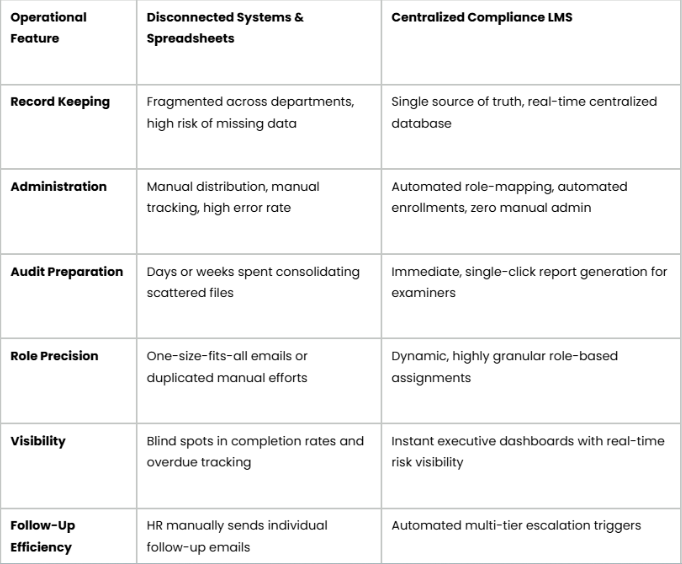
Centralized Platform vs. Disconnected Systems & Spreadsheets
Many organizations still attempt to manage workforce training across disjointed channels—using spreadsheets, separate departmental portals, and manual email follow-ups. Comparing these two models illustrates why single-platform consolidation is critical for enterprise governance:
Regulatory Alignment and Best Practices in the UAE BFSI Sector
In the UAE, regulatory authorities such as the Central Bank of the UAE (CBUAE), the Dubai Financial Services Authority (DFSA), and the Financial Services Regulatory Authority (FSRA) emphasize robust governance, staff competence, and documented training programs.
Key Regulatory Considerations (CBUAE Guidelines)
Risk-Based Depth: CBUAE AML/CFT guidelines state that training must be tailored to the institution’s specific ML/FT risk exposure, business activities, and individual employee roles.
Strict Timelines: New joiners must undergo compliance training within 30 days of joining, and front-line staff require regular, at least annual, refreshers.
Audit-Ready Registers: Licensed entities must maintain comprehensive training registers—including policy records, completion logs, assessment scores, and attendance evidence—for inspection by Central Bank examiners.
Regulatory guidelines vary by entity size, business model, and supervisory authority. The discussion above outlines standard regulatory frameworks and best practices in the UAE; it does not constitute formal legal or regulatory advice.
Checklist: What to Look For in a Multi-Group Compliance Training Platform
When evaluating a compliance lms in UAE financial institutions, ensure the technology supports these essential capabilities:
Dynamic Role-Based Assignments: Ability to segment staff automatically via HRIS data.
Custom Group Hierarchies: Support for departments, branches, subsidiaries, and functional risk tiers.
Automated Recurrence Engines: Configurable schedules for annual, biannual, or trigger-based training.
Assessment & Knowledge Verification: Randomized testing, minimum score thresholds, and retake rules.
Certification & Expiry Monitoring: Automatic tracking of certificate validity and renewal alerts.
Real-Time Audit Reporting: Exportable, detailed compliance logs showing timestamps and score histories.
Automated Escalation Workflows: Automated notification loops for managers when training becomes overdue.
Multilingual Support: Seamless switching between Arabic and English interfaces and content.
Mobile Learning Accessibility: Secure mobile access for field staff and remote employees.
Centralized Data Security: Secure cloud or on-premise deployment options compliant with local data sovereignty standards.
Streamlining Enterprise Training with e-KHOOL
Managing complex, multi-audience training schedules requires robust, enterprise-grade technology. e-KHOOL provides an advanced lms platform engineered to solve multi-group training challenges for modern enterprises.
Through its configurable learning architecture, e-KHOOL enables UAE organizations to:
Automate Onboarding & Role Assignments: Automatically enrol new hires and promoted staff into their required compliance paths based on HR metadata.
Track Expiries & Recurrences: Monitor certification lifecycles with built-in expiry notifications and scheduled re-certification modules.
Deliver Assessment-Backed Compliance: Verify comprehension through built-in quiz engines and issue official, verifiable certificates.
Simplify Audits: Generate real-time, institution-wide training registers and completion proof for compliance officers and external regulators in seconds.
Support Multilingual Workforces: Deliver seamlessly structured learning in both Arabic and English, ensuring equal comprehension across diverse teams.
While e-KHOOL LMS delivers robust infrastructure for organizing, tracking, and automating learning, overall compliance success depends on an organization’s internal content quality, risk assessment accuracy, and operational governance.
Conclusion
Can one centralized platform handle training for multiple employee groups with different requirements? Yes. By deploying an enterprise platform built around dynamic role mapping, automated learning paths, robust assessment engines, and real-time reporting, organizations can successfully manage diverse learning demands on a single system.
Instead of managing scattered systems or manual spreadsheets, financial institutions can maintain high training standards, ensure operational efficiency, and maintain audit readiness across every tier of their workforce.
Explore e-KHOOL for Your Enterprise
Looking to centralize compliance training and role-based learning across your organization?
Request a Personalized Demo with the e-KHOOL Team to see how our platform streamlines complex workforce training.
Frequently Asked Questions (FAQs)
Can one LMS manage different employee training requirements?
Yes. Modern learning management software allows administrators to create distinct user groups, departments, and role profiles. The platform automatically assigns tailored content, assessments, and recurring compliance requirements to each group based on their specific job mandates.
How does role-based training work in an LMS?
Role-based training maps specific learning tracks directly to job titles or risk levels. By integrating with an organization’s HRIS, the LMS automatically assigns required courses when an employee joins, changes roles, or receives a promotion, ensuring they receive relevant learning without manual administrator intervention.
Can an LMS manage mandatory compliance training?
Yes. A compliance LMS automates the assignment, delivery, tracking, and reporting of mandatory training. It monitors deadlines, sends automated reminders to staff and managers, tracks assessment results, and generates audit-ready reports.
Can different departments have different learning paths?
Yes. Administrators can set up custom learning paths for separate departments (e.g., Branch Banking, Risk, IT, Legal). Each department sees a customized dashboard containing only the courses, resources, and compliance paths assigned to their unit.
Can an LMS track certification expiry?
Yes. Advanced platforms track certificate validity periods and trigger automated renewal notifications prior to expiration. This ensures employees complete mandatory refresher training on time to maintain active compliance standing.
What should financial institutions look for in a compliance LMS?
Financial institutions should look for dynamic role mapping, automated recurring training engines, customizable assessment tools, real-time audit reporting, strong data security, multilingual support (Arabic/English), and mobile learning access.