Automating Compliance Training Assignments for UAE BFSI | Compliance LMS
Managing mandatory regulatory learning in the United Arab Emirates' banking, financial services, and insurance (BFSI) sectors is a complex operational task. As financial institutions expand across physical branches and digital channels, human resources (HR), Learning & Development (L&D), and compliance teams face the challenge of keeping every employee aligned with evolving internal policies and industry standards.
Historically, organizations relied on manual administration using spreadsheets, static email lists, separate course allocations, and repeated manual follow-ups to assign required learning. However, as workforce numbers grow and roles become more specialized, these traditional methods quickly reveal their limitations. A single missing entry in a spreadsheet can lead to untracked training gaps, unassigned mandatory courses, and a lack of visibility for leadership.
Implementing a modern compliance LMS allows institutions to transition from fragmented, manual tracking to an automated, centralized learning management environment. By automating the end-to-end training life cycle from initial role identification to real-time completion tracking organizations can maintain consistent workforce development while eliminating heavy administrative burdens.
What Makes Compliance Training Assignments Complex in BFSI?
Training requirements within financial institutions are rarely one-size-fits-all. A major complexity when managing an LMS for banks and finance is that distinct job functions require tailored learning paths based on their daily responsibilities, seniority levels, and operational risks.
Consider how learning requirements vary across different functional areas within a typical financial institution:
Frontline and Branch Personnel: Focus on Know Your Customer (KYC) protocols, anti-money laundering (AML) red flags, customer conduct standards, and branch operational controls.
Compliance and Risk Teams: Require deep technical training on regulatory frameworks, advanced financial crime prevention, corporate governance, and risk assessment methodologies.
Operations and IT Units: Focus on data privacy frameworks, cybersecurity awareness, fraud detection, and internal process controls.
Management and Executives: Need training centered on conduct risk, managerial oversight, fiduciary responsibilities, and enterprise-wide governance.
In addition to departmental distinctions, factors such as geographic location, new-hire onboarding status, and recurring training intervals add layers of complexity. Relying on manual workflows to map hundreds or thousands of employees to their respective learning paths creates significant overhead and increases the risk of human error. Using an integrated LMS for BFSI simplifies this matrix by managing these dynamic variables automatically.
How a Compliance LMS Automates Course Assignments
At the core of an automated compliance training platform is a dynamic engine designed to eliminate manual intervention from daily assignment workflows. Rather than manually cross-referencing HR records with course rosters, administrators can establish dynamic rules that govern how learning is distributed.
Key features that facilitate automated course distribution include:
Dynamic Employee Grouping
The system organizes users into logical cohorts based on organizational parameters such as department, business unit, job title, office location, and hire date. When an employee profile is updated in the system, their group memberships adjust automatically.
Rule-Based Course Mapping
Administrators set predefined assignment rules (e.g., "Assign Course X to all employees where Department = Wealth Management and Role = Relationship Manager"). The system continuously evaluates these rules, ensuring new additions or transfers instantly receive the correct curriculum.
Automated Recurring Allocations
For courses that require periodic updates such as annual ethics refreshers or updated data privacy policies the platform automatically re-enrolls target groups at defined intervals without requiring L&D teams to rebuild distribution lists from scratch.
Role-Based Training Assignments for UAE BFSI Employees
Assigning universal compliance content to every employee regardless of their job function can lead to training fatigue and lower engagement. A robust learning management software platform enables role-based training assignments that deliver targeted, relevant content to specific employee segments.
Banking Sector
In commercial banking, teller staff require operational training on counterfeit detection and cash-handling controls, whereas credit risk analysts require training on loan underwriting governance and portfolio risk monitoring. Role-based automation ensures both groups receive training directly applicable to their day-to-day duties.
Financial Services & Investment Firms
Investment advisors and portfolio managers need specialized instruction on market conduct, conflict of interest management, and investor protection guidelines. Meanwhile, back-office settlement teams focus on transaction processing safeguards and reconciliation controls.
Insurance Companies
Insurance underwriters require targeted learning around policy terms, fraud detection, and risk assessment, while claims adjusters focus on claims investigation standards and consumer protection practices.
By utilizing dynamic role mapping within a centralized learning system, institutions ensure that employees complete training tailored directly to their operational realities.
Automating New-Hire Compliance Training
Onboarding new team members in the financial sector requires delivering necessary compliance training promptly upon their start date. Manual onboarding processes often delay course distribution, leading to inconsistent learning timelines for new hires.
A dedicated compliance training platform streamlines the onboarding workflow into an automated sequence:
HR Systems Synchronization: The new employee’s profile is created and populated with metadata (role, department, location).
Automated Triggering: The system identifies the new profile and automatically triggers the corresponding onboarding learning plan.
Curriculum Assignment: Mandatory foundational modules such as code of conduct, information security, and basic AML principles are added to the employee's dashboard.
Deadline Establishment: The platform assigns individualized completion deadlines based on the employee's start date (e.g., within 14 days of joining).
System Notifications: The employee receives automated welcome communications containing direct login access and personalized schedule timelines.
Assessment & Record Keeping: As the employee completes modules and assessments, status updates are logged immediately in their central transcript.
This automated structure reduces time spent on administrative setup, giving HR and L&D leaders confidence that every new team member receives essential training from day one.
Automating Recurring Compliance Training
Training requirements in financial institutions are ongoing. Internal policies, operational procedures, and industry standards evolve over time, requiring organizations to conduct periodic training updates and policy acknowledgments.
Manually managing recurring learning cycles across an enterprise often leads to administrative bottlenecks. A modern compliance LMS automates recurring training by maintaining systematic re-enrollment schedules:
Automated Refresher Cycles: System administrators can configure rules to automatically re-assign specific modules at set calendar intervals or relative timeframes (e.g., every 12 months after initial completion).
Policy Version Control: When internal operating policies or guidelines are updated, administrators can trigger targeted redistribution of revised materials to affected roles, requiring re-acknowledgment.
Automated Deadline Management: The platform automatically sets personalized completion windows for each renewal cycle, preventing administrators from having to track renewal dates manually in external spreadsheets.
By establishing automated recurring schedules, institutions maintain an active, ongoing learning cadence across all business units.
Automated Notifications and Training Reminders
Even with well-structured learning paths, keeping employees on schedule requires consistent communication. Relying on L&D or compliance staff to manually draft and send reminder emails is inefficient and difficult to scale.
An enterprise elearning platform automates the entire notification workflow through customizable triggers:
Initial Enrollment Alerts: Sent immediately upon course assignment to outline learning objectives and completion deadlines.
Scheduled Deadline Reminders: Timed communications dispatched at customizable intervals (e.g., 14 days, 7 days, and 1 day prior to due dates).
Overdue Notifications: Escalation alerts sent to employees and their direct line managers when a deadline passes without course completion.
Completion Acknowledgments: Instant confirmation messages dispatched upon successful completion of a course or assessment.
Automating these communications eliminates repetitive follow-up tasks for HR and compliance administrators, allowing them to focus on high-value learning initiatives while maintaining steady completion rates across the organization.
Tracking Training Completion After Automated Assignment
Assigning training is only the first phase of an effective learning strategy. Once courses are distributed, administrators require clear, real-time visibility into workforce progress across departments and branch networks.
Centralized learning platforms provide continuous tracking by maintaining precise, real-time status categories for every user profile:
Assigned: The course has been successfully allocated to the employee dashboard, but interaction has not yet begun.
In Progress: The employee has accessed the material and is working through the learning modules.
Completed: All learning objectives, required viewing times, and embedded knowledge checks have been met.
Assessment Status: Tracks pass/fail results, test scores, and attempt counts for formal course evaluations.
Overdue: Highlights records that have breached assigned completion windows, allowing for quick operational follow-up.
Moving away from static spreadsheets to dynamic tracking dashboards gives management an accurate, up-to-the-minute view of organizational progress.
How an Elearning Platform Supports Automated Compliance Learning
Beyond back-end administration, the user experience plays a major role in achieving high completion rates. A modern distance learning platform offers a flexible learning environment tailored to today’s distributed financial workforces.
Core learning delivery capabilities include:
Self-Paced Digital Courses: Enables staff to complete training modules around their operational workloads without disrupting daily client services.
Mobile and Multi-Device Access: Allows team members across different branch locations, corporate offices, or remote environments to access learning materials securely from desktop or mobile devices.
Interactive Knowledge Checks: Incorporates quizzes, scenario-based evaluations, and formal assessments directly into the learning experience to reinforce key concepts.
Structured Learning Paths: Groups individual modules into clear, sequential learning journeys that guide employees step-by-step through complex operational topics.
Combining flexible delivery with automated administration creates an efficient ecosystem for both learners and administrators.
Reporting on Automated Training Assignments
Systematic training distribution generates valuable operational data. A LMS in UAE centralizes this information into actionable dashboards and exportable reports, giving leaders immediate insight into workforce capability and training engagement.
Key reporting views include:
Enterprise Completion Dashboards: Macro-level visual charts displaying overall completion rates across the entire organization.
Departmental and Branch Breakdown: Comparative reports showing progress across specific business units, branches, or subsidiary entities.
Role-Based Status Summaries: Granular tracking of completion progress for specific high-priority operational roles.
Assessment Performance Metrics: Detailed score distributions and question-level analytics to identify areas where employees may need additional support or clearer training materials.
Historical Learning Transcripts: Centralized individual records detailing historical course completions, assessment scores, and completion timestamps.
Having centralized report generation available on demand eliminates the task of manually aggregating data across multiple departmental spreadsheets.
What UAE BFSI Organizations Should Look for in a Compliance LMS
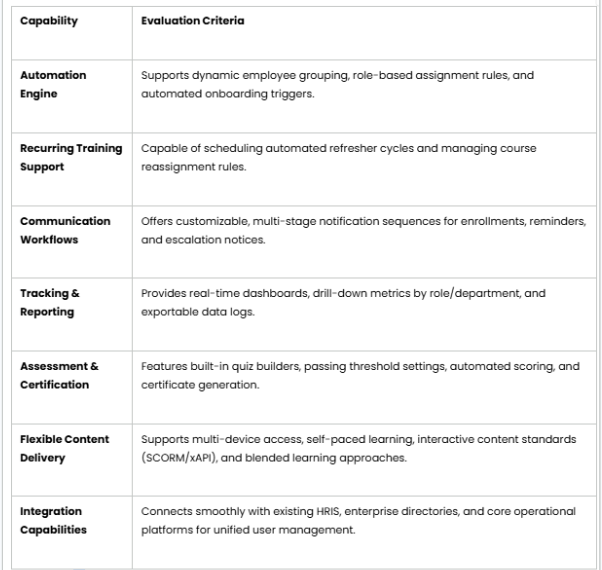
When selecting an enterprise learning platform to automate training management, decision-makers should evaluate systems against key functional requirements:
How e-KHOOL Can Support Automated Compliance Training
For financial institutions seeking a scalable learning management infrastructure, e-KHOOL provides a comprehensive environment built to streamline the corporate learning lifecycle.
[Employee Profile] ──► [Automated Rule] ──► [Role-Based Module] ──► [Automated Reminder] ──► [Central Reporting]
As an advanced learning management software platform, e-KHOOL supports organizations at every stage of the training workflow:
Dynamic Rule-Based Assignments: Automatically maps employees to specific learning paths based on role, department, location, or customized attributes.
Onboarding & Recurrent Cycles: Manages structured new-hire training pipelines alongside automated periodic refresher schedules.
Flexible Learning Delivery: Delivers self-paced digital courses, interactive assessments, digital certificates, and mobile-friendly content.
Automated Communication Engine: Handles enrollment notifications, upcoming deadline alerts, and overdue reminders without manual intervention.
Comprehensive Analytics: Delivers centralized reporting dashboards that give L&D, compliance, and executive leadership clear visibility into enterprise-wide training progress.
By deploying e-KHOOL, UAE banking, financial services, and insurance organizations can replace fragmented, manual processes with a structured, automated learning ecosystem tailored to enterprise demands.
From Manual Assignments to Automated Compliance Learning
Relying on manual spreadsheets, localized email threads, and disconnected tracking documents creates administrative friction and leaves institutions vulnerable to operational blind spots. As workforce headcount and operational requirements scale, manual approaches become increasingly inefficient.
Adopting an automated compliance LMS transforms workforce training management across every operational stage:
Shift from manual distribution to automated, role-based assignments.
Transition from individual email follow-ups to automated notification schedules.
Replace fragmented spreadsheets with centralized visual dashboards.
Upgrade from generic course delivery to targeted learning paths.
Transform manual data collection into real-time enterprise tracking.
By centralizing and automating the training lifecycle, financial institutions can eliminate heavy administrative burdens, ensure consistent learning delivery, and give leadership complete visibility into employee development across the enterprise.
Explore how e-KHOOL LMS can help your organization streamline course delivery, automate training assignments, and centralize workforce learning management.